Author: BhaktiParv.com
Shree Krishna is one of the most loved, worshipped, and deeply philosophical divine figures in Hinduism. For millions of devotees around the world, Shree Krishna is not only God but also a friend, guide, teacher, and eternal source of wisdom. The question “Who is Shree Krishna?” goes far beyond mythology—it touches spirituality, philosophy, devotion, and human life itself.
In Hindu belief, Shree Krishna is the eighth avatar of Lord Vishnu, who descended on Earth to restore righteousness (Dharma), destroy evil forces, and guide humanity toward truth and liberation. His life, teachings, and divine play (Leela) continue to influence culture, art, music, literature, and spiritual thought even today.
Shree Krishna is one of the most worshipped and spiritually significant divine figures in Hinduism. Millions of devotees across the world seek to understand his life, teachings, and divine purpose.
Table of Contents
- Understanding the Divine Nature of Lord Krishna
- Birth of Lord Krishna: A Divine Beginning
- Childhood Leelas: Expressions of Joy and Wisdom
- Radha and Krishna: The Highest Form of Devotion
- Krishna’s Role in the Mahabharata
- Teachings of the Bhagavad Gita
- Why Krishna Is Considered a Complete Divine Form
- Symbolic Meaning of Lord Krishna
- Relevance of Krishna’s Teachings Today
- Festivals Celebrating Lord Krishna
- Global Devotion to Krishna
- Final Thoughts
- Frequently Asked Questions (FAQs)
Understanding the Divine Nature of Lord Krishna
In Hindu philosophy, Lord Krishna is regarded as one of the highest expressions of divinity. Many Vaishnav traditions revere him as the Supreme Being, while others honor him as a divine incarnation of Lord Vishnu. Across beliefs, Krishna is worshipped as a complete and compassionate form of God who guides humanity toward righteousness.
He beautifully represents the essence of spiritual life, including:
- Pure divine love and compassion
- Extraordinary intelligence and strategic wisdom
- Eternal truth and higher consciousness
- Joy, music, creativity, and celebration of existence
What makes Krishna truly unique is his ability to harmonize opposites. He effortlessly balances playfulness with responsibility, discipline with affection, devotion with action—showing that spiritual growth does not require rejecting life, but understanding it deeply.
Birth of Lord Krishna: A Divine Beginning
Lord Krishna was born in the city of Mathura under extraordinary circumstances. His birth took place inside a prison ruled by the tyrant King Kansa, who feared a prophecy that foretold his downfall through Devaki’s eighth child. Driven by fear, Kansa imprisoned Devaki and Vasudeva.
On the sacred night of Janmashtami, a divine miracle unfolded. As the child was born:
- The prison gates opened on their own
- Guards fell into deep sleep
- The Yamuna River parted to allow safe passage
Vasudeva carried the newborn to Gokul, where Krishna was lovingly raised by Yashoda and Nanda Baba, far away from danger. This divine event symbolizes a timeless spiritual truth—when darkness reaches its extreme, divine light naturally emerges.
Childhood Leelas: Expressions of Joy and Wisdom
Krishna’s early years in Gokul and Vrindavan are filled with enchanting stories known as leelas. These divine acts are not merely playful tales but carry profound spiritual lessons about love, faith, and surrender.
Some well-known childhood leelas include:
- Stealing butter and spreading joy among villagers
- Lifting Govardhan Hill to protect people from disaster
- Defeating negative forces sent by Kansa
- Playing the flute and filling hearts with devotion
Through these acts, Krishna teaches that divine presence can be joyful, loving, and deeply transformative.
Radha and Krishna: The Highest Form of Devotion
The bond between Radha and Krishna goes far beyond worldly romance. Spiritually, it represents the eternal relationship between the soul and the Supreme.
In this divine symbolism:
- Radha represents the individual soul
- Krishna represents the ultimate divine reality
Their love reflects pure devotion—free from ego, expectation, or attachment—showing that true surrender leads to spiritual fulfillment.
Krishna’s Role in the Mahabharata
As Krishna matured, his role became central to the great epic Mahabharata. Without wielding weapons, he influenced the course of history through wisdom, diplomacy, and divine insight.
His contributions included:
- Guiding and protecting the Pandavas
- Attempting peace through diplomacy
- Serving as Arjuna’s charioteer
- Ensuring the triumph of righteousness
Krishna’s presence ensured that moral order prevailed over injustice and ego.
Teachings of the Bhagavad Gita
The Bhagavad Gita stands as the core of Krishna’s spiritual guidance. Delivered on the battlefield of Kurukshetra, it addresses human confusion, duty, fear, and purpose.
Krishna explains three essential spiritual paths:
- Karma Yoga – Acting selflessly without attachment
- Bhakti Yoga – Devotion rooted in love and surrender
- Jnana Yoga – Wisdom gained through knowledge
One of his most powerful messages encourages people to perform their duties sincerely while letting go of obsession with outcomes—a principle that remains relevant in every era.
Why Krishna Is Considered a Complete Divine Form
Krishna is often referred to as a Purna Avatar, meaning a complete manifestation of divinity. He embodies every noble quality—strength and gentleness, wisdom and joy, detachment and deep love.
Through his life, Krishna shows that spirituality is not about withdrawing from the world, but about living fully while staying aligned with truth and righteousness.
Symbolic Meaning of Lord Krishna
Every feature associated with Krishna carries deep symbolism:
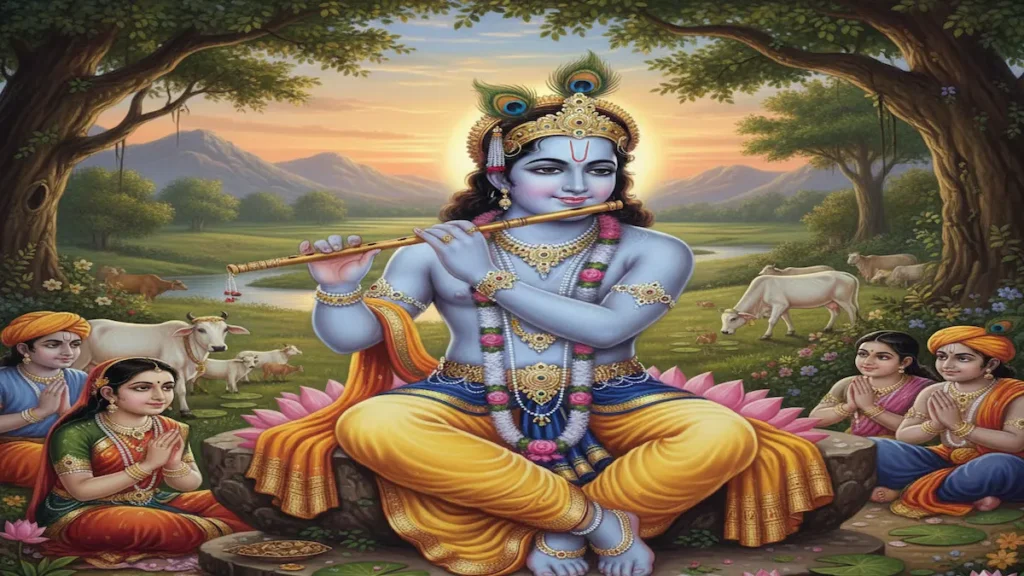
- Flute symbolizes surrender of ego
- Peacock feather reflects beauty and humility
- Blue complexion represents infinity and depth
- Gentle smile expresses eternal bliss beyond suffering
These symbols remind devotees to remain joyful, balanced, and spiritually aware even in difficult times.
Relevance of Krishna’s Teachings Today
In modern life filled with stress and uncertainty, Krishna’s teachings offer practical guidance:
- Anxiety is reduced through detachment
- Confusion is resolved by following righteous principles
- Ego is softened through devotion and humility
Krishna teaches how to balance spiritual awareness with everyday responsibilities without escaping reality.
Festivals Celebrating Lord Krishna
Several major festivals honor Krishna’s divine presence, including:
- Janmashtami, celebrating his birth
- Holi, symbolizing divine love and joy
- Govardhan Puja, highlighting faith and gratitude
These celebrations keep Krishna’s wisdom alive within cultural traditions.
Global Devotion to Krishna
Devotion to Krishna extends far beyond India. Spiritual movements across the world promote Krishna consciousness through prayer, service, and study of sacred texts. His message resonates universally, crossing boundaries of religion and geography.
Final Thoughts
Lord Krishna is not confined to scriptures or history alone. He lives through wisdom, love, responsibility, and devotion. His life inspires humanity to act righteously, love selflessly, and face challenges with inner strength.
To understand the essence of Krishna is to understand life itself—its struggles, joys, and deeper purpose. Whether seen as a playful child, a divine guide, or a timeless teacher, Krishna continues to illuminate the spiritual path for seekers everywhere.
Frequently Asked Questions (FAQs)
1.Who is Shree Krishna in simple words?
Shree Krishna is a Hindu God and spiritual teacher who teaches how to live a righteous, loving, and balanced life.
2.Is Shree Krishna a real historical figure?
Krishna is both a historical and divine figure, described in ancient scriptures like the Mahabharata and Bhagavad Gita.
3.Why is Shree Krishna worshipped so widely?
Because his teachings apply to everyone—students, workers, leaders, and spiritual seekers.
4.What is Shree Krishna famous for?
He is famous for his childhood leelas, love for Radha, and teachings of the Bhagavad Gita.
5.What can we learn from Shree Krishna?
We learn selfless action, devotion, wisdom, emotional balance, and faith in divine order.
Category: Krishna | Hindu Gods | Hindu Festivals