


Author: BhaktiParv.com
Introduction
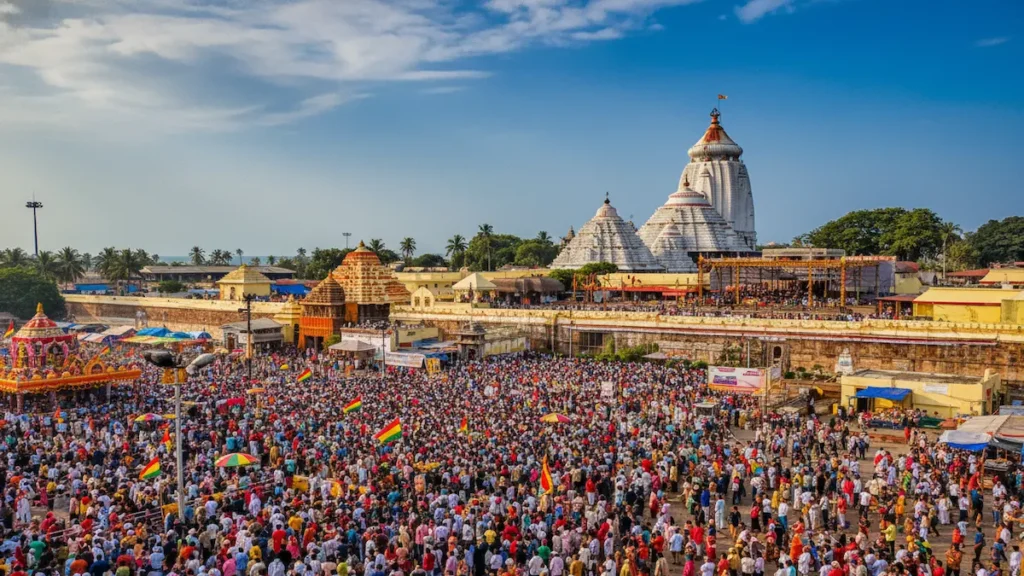
Jagannath Mandir stands as a monumental centre of Hindu pilgrimage, devotion, and civilizational heritage in the coastal city of Puri, Odisha. Dedicated to Lord Jagannath, a divine manifestation of Bhagwan Krishna, the temple has cultivated spiritual traditions, cultural unity, and artistic excellence for many centuries. Its rituals, festivals, architecture, and theological significance place it among the most sacred religious landmarks of Bharat. Millions of devotees and pilgrims arrive annually to seek blessings, witness rituals, experience Mahaprasad, and participate in the iconic Rath Yatra festival. The temple continues to embody a living tradition of bhakti that transcends regions, languages, and communities.
Table of Contents
- History of Jagannath Mandir
- Architectural Features of Jagannath Temple
- Religious Significance and Spiritual Legacy
- The Grand Rath Yatra of Puri
- Rituals, Sevas and Daily Worship Traditions
- Mahaprasad and Annaprasad Tradition
- Festivals Celebrated at Jagannath Mandir
- Best Time for Darshan and Travel Tips
- Accommodation, Route and Logistic Guide
- Cultural Influence and Traditional Heritage
- Final Thoughts
- FAQ
History of Jagannath Mandir
Jagannath Mandir traces its origin to the 12th century under the patronage of King Anantavarman Chodaganga Deva of the Eastern Ganga dynasty. The temple soon emerged as a beacon of dharma, attracting saints, poets, and spiritual pilgrims from across the Indian subcontinent. Over centuries, Jagannath Mandir played an essential role in shaping the larger bhakti movement, influencing devotional songs, classical dance, and sacred literature. Numerous historical references, copper plate grants, and royal inscriptions highlight the temple’s continual support from dynasties such as the Gajapatis of Odisha.
Its historical prominence expanded beyond religion, strengthening maritime connections, cultural diplomacy, and intellectual exchanges between India and Southeast Asia. Such influence demonstrates that Jagannath Mandir has never been a static monument; rather, it functions as a dynamic cultural institution representing India’s civilizational continuity.
Architectural Features of Jagannath Temple
Jagannath Mandir showcases classical Kalinga temple architecture with monumental symmetry, elevated sanctum, and intricate carvings. The temple complex is surrounded by strong fortified walls known as Meghanada Prachira, while the main shikhara dominates the sacred skyline of Puri. The structural alignment follows ancient architectural principles linked to sacred geometry and ritual choreography.
The main complex comprises the Vimana (sanctum), Jagamohana (assembly hall), Nata Mandira (dance hall), and Bhoga Mandapa (food offering hall). The sacred triad of Jagannath, Balabhadra, and Subhadra resides in the sanctum, made uniquely from Daru (sacred neem wood). Through the Nabakalebara tradition, the deities undergo renewal in specific lunar cycles every twelve to nineteen years, symbolizing divine rebirth and cosmic transformation.
Religious Significance and Spiritual Legacy
Jagannath Mandir holds a revered position in Hindu dharma. It forms one of the sacred Char Dham pilgrimage sites along with Badrinath, Dwarka, and Rameswaram. For Vaishnavas, Jagannath is Krishna in universal form. For Shaivas, He symbolizes consciousness. For Shaktas, the deity manifests prakriti and cosmic energy. This theological inclusiveness played a major role in integrating diverse spiritual lineages into a common devotional culture.
Bhakti saints such as Jayadeva, Sri Chaitanya Mahaprabhu, Kabir, Tulsidas, and others shaped devotional literature inspired by Jagannath. Classical dance traditions, especially Odissi, flourished within the temple ecosystem. Music, poetry, kirtans, and manuscript culture further nurtured the philosophy of devotion anchored in Jagannath’s grace.
The Grand Rath Yatra of Puri
Rath Yatra represents the most celebrated and globally recognized festival of Jagannath Mandir. Lord Jagannath, Balabhadra, and Subhadra are placed on grand wooden chariots and taken from the main temple to the Gundicha Temple. The act of pulling ropes symbolizes spiritual participation, collective devotion, and divine-human connection. Millions gather annually, making it one of the largest religious gatherings in the world.
The chariots are constructed anew each year by hereditary craftsmen who follow ancient measurements linked to sacred mathematical proportions. The festival symbolizes cosmic movement—Bhagwan stepping out of the sanctum to bless devotees who may not access the inner sanctum otherwise. Rath Yatra reinforces the universal and compassionate nature of Jagannath.
Rituals, Sevas and Daily Worship Traditions
Jagannath Mandir functions through a sophisticated schedule of daily rituals, seasonal observances, and annual festivals. The day begins with mangala arati and continues with various sevas, veshas (attire changes), bhoga offerings, and musical recitations. The rituals are performed by temple sevayats who inherit sacred duties through lineage.
Public participation forms a unique dimension of Jagannath worship. Rituals like pahandi and rath seva embody collective devotion rather than restricted ritual exclusivity. The temple thus preserves an ancient ritual ecosystem that integrates community, art, theology, and social unity.
Mahaprasad and Annaprasad Tradition
Mahaprasad of Jagannath Mandir is among the most sacred devotional food offerings in Hindu tradition. Cooked in earthen pots over traditional firewood stoves, Mahaprasad represents divine hospitality and community nourishment. Distributed through the Ananda Bazaar, it eliminates social hierarchy by encouraging devotees to share meals irrespective of background. The Mahaprasad system reinforces compassion, equality, and collective participation in sacred space.
Festivals Celebrated at Jagannath Mandir
Besides Rath Yatra, several major festivals enrich the ritual calendar of Jagannath Mandir, including:
- Snana Yatra
- Chandan Yatra
- Dola Yatra
- Niladri Bije
- Makara Sankranti
- Kartika Purnima
- Ratha Dashami
- Nabakalebara (occasion-based)
Each festival integrates theological meaning with artistic expression, drawing pilgrims, scholars, and cultural enthusiasts.
Best Time for Darshan and Travel Tips
The best time to visit Jagannath Mandir is between October and February due to pleasant weather. Devotees visiting during Rath Yatra experience the highest devotional energy, although it requires logistical planning due to the massive crowd. For quieter darshan, non-festival months provide smoother experiences. Early morning darshan remains highly preferred for spiritual focus and calm ambiance. Visitors must adhere to dress codes, security rules, and temple restrictions encouraging sanctity and respect.
Accommodation, Route and Logistic Guide
Puri is accessible via road, rail, and air. The nearest airport lies in Bhubaneswar, around 60 km away. Puri railway station connects major Indian cities, ensuring easy pilgrimage travel. Local commute options include auto-rickshaws, taxis, and buses. The city also offers a wide spectrum of accommodations ranging from dharmashalas, ashrams, budget lodges to mid-range hotels and luxury resorts. Many establishments support vegetarian dining and pilgrimage services.
Pilgrims often combine Jagannath Mandir with visits to Konark Sun Temple, Bhubaneswar temples, Chilika Lake, and coastal sites. The proximity of the Bay of Bengal adds a serene maritime dimension to the journey.
Cultural Influence and Traditional Heritage
Jagannath Mandir shapes India’s cultural heritage through dance, music, literature, sculpture, and culinary traditions. It nurtured classical Odissi dance and temple music genres, influenced textile arts such as patta paintings, and supported the rise of devotional literature. Throughout history, Jagannath Mandir played a key role in maritime cultural exchanges across Southeast Asia, reflecting India’s ancient oceanic civilization.
Above all, the temple promotes inclusiveness. Mahaprasad distribution, public rituals, and participatory festivals reinforce equality and collective identity. The temple remains a living cultural ecosystem rather than a static historical monument.
Final Thoughts
Jagannath Mandir symbolizes timeless devotion, cultural depth, and civilizational heritage. Its spiritual aura, historical legacy, architectural magnificence, and festival culture continue to inspire millions across India and the world. For devotees, Jagannath represents universal compassion and divine grace. For scholars and travelers, the temple offers a profound window into India’s ancient dharma traditions and cultural vibrancy. The pilgrimage to Puri remains a transformative experience that blends spirituality, history, art, cuisine, and community into a single sacred journey.
FAQ
Jagannath Mandir as a Char Dham pilgrimage
Jagannath Mandir is one of the four sacred Char Dham pilgrimage sites of Bharat.
Rath Yatra and global recognition
The annual Rath Yatra of Puri stands as one of the largest and most celebrated religious gatherings in the world.
Mahaprasad and community sharing tradition
Mahaprasad represents sacred nourishment and reinforces social equality in devotional space.
Category: Jagannath Mandir | Hindu Temples | Pilgrimage