Author: BhaktiParv.com
Introduction
Lord Shiva History reflects one of the most profound and timeless spiritual traditions in Hindu philosophy. Lord Shiva, known as the destroyer and transformer in the holy Trinity of Brahma, Vishnu, and Mahesh, represents the cosmic force that dissolves illusion and leads the soul toward liberation. His presence is not limited to mythology alone; it lives in meditation, devotion, sacred scriptures, and the hearts of millions of devotees across the world.
This detailed exploration of Lord Shiva History presents his divine origin, symbolic form, sacred legends, spiritual teachings, and eternal relevance in human life. The narrative flows through ancient scriptures, Puranic traditions, and philosophical meanings that continue to guide seekers on the path of truth and inner awakening.
Table of Contents
- Divine Meaning of Lord Shiva in Hindu Tradition
- Origin and Cosmic Nature of Lord Shiva
- Symbolism of Shiva’s Form and Sacred Attributes
- Sacred Legends That Define Lord Shiva History
- Lord Shiva in Vedas, Upanishads, and Puranas
- Spiritual Teachings and Philosophical Significance
- Major Festivals and Worship Traditions of Lord Shiva
- Eternal Relevance of Lord Shiva in Modern Life
- Final Thoughts
- FAQ
Divine Meaning of Lord Shiva in Hindu Tradition
Lord Shiva stands beyond ordinary definitions of creation and destruction. In Lord Shiva History, destruction is not an end but a sacred transformation that clears the path for renewal. Shiva symbolizes silence, meditation, detachment, and ultimate truth.
He is called Mahadev, the greatest of all gods, and Bholenath, the innocent and compassionate lord who blesses devotees without complexity. His energy balances the universe, ensuring harmony between creation, preservation, and dissolution.
In spiritual understanding, Shiva is pure consciousness. He is the stillness behind movement, the silence behind sound, and the truth behind illusion. This deeper meaning forms the foundation of Lord Shiva History across centuries.
Origin and Cosmic Nature of Lord Shiva
Ancient scriptures describe Lord Shiva as self-manifested, without beginning or end. Unlike other divine forms connected to birth stories, Shiva exists beyond time. In many Puranic narratives, he appears as an infinite pillar of light, known as the Shiva Lingam, symbolizing eternal cosmic energy.
Lord Shiva History explains that he resides in Mount Kailash, a sacred spiritual center representing inner stillness and higher consciousness. Kailash is not merely a geographical place but a symbol of the awakened mind.
His union with Goddess Parvati represents the balance of consciousness and energy, known as Shiva-Shakti. Without Shakti, Shiva is pure awareness; with Shakti, creation unfolds. This unity defines the cosmic rhythm of existence.
Symbolism of Shiva’s Form and Sacred Attributes
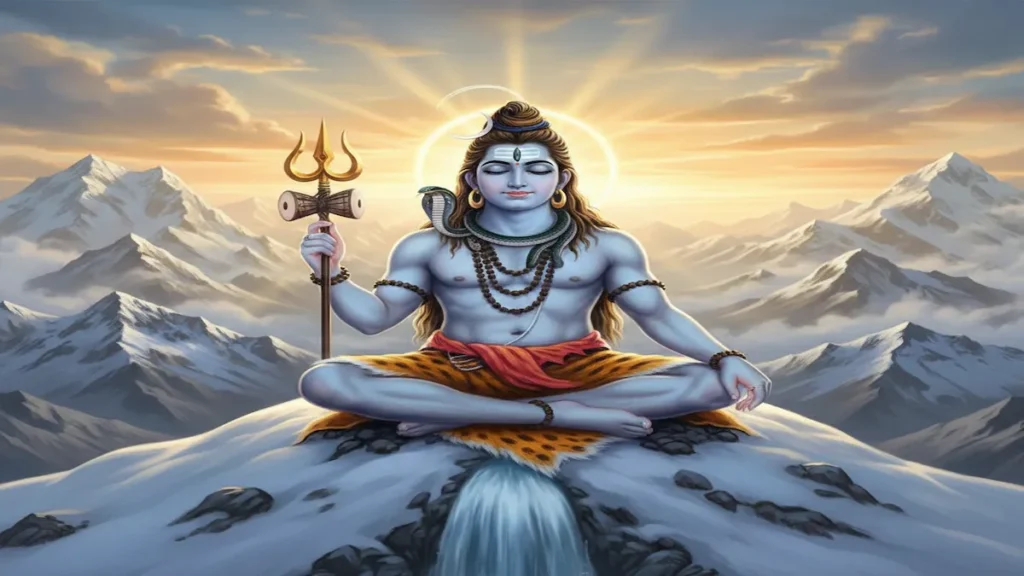
Every element in Lord Shiva’s appearance carries deep philosophical meaning.
Third Eye – Represents higher wisdom that burns ignorance and illusion.
Crescent Moon – Symbolizes control over time and the calm rhythm of life.
River Ganga – Flowing from his hair shows purification of the soul and divine grace.
Blue Throat (Neelkanth) – Reminds devotees of sacrifice for the protection of the universe.
Trident (Trishul) – Reflects control over mind, body, and soul, and the three cosmic qualities.
Damru – Represents the sound of creation and universal vibration.
Snake Around the Neck – Shows mastery over fear, ego, and death.
Ash-Covered Body – Teaches detachment from material illusion and acceptance of impermanence.
These symbols make Lord Shiva History not only mythological but deeply philosophical and spiritual.
Sacred Legends That Define Lord Shiva History
Numerous legends shape the divine narrative of Shiva.
One of the most powerful stories tells of Samudra Manthan, where a deadly poison emerged from the cosmic ocean. To save all creation, Shiva drank the poison and held it in his throat, turning it blue. This act of compassion defines his identity as protector of the universe.
Another sacred legend describes the appearance of Ardhanarishvara, the half-male, half-female form of Shiva and Parvati. This symbolizes the inseparable unity of masculine and feminine energies within existence.
The story of Tripura Samhara shows Shiva destroying three cities of evil forces, representing the removal of ego, desire, and ignorance from human consciousness.
Each legend in Lord Shiva History carries moral and spiritual meaning rather than simple storytelling.
Lord Shiva in Vedas, Upanishads, and Puranas
The presence of Shiva can be traced to the Rigveda, where he appears in the form of Rudra, a powerful yet compassionate deity. Over time, Rudra evolved into the supreme ascetic known as Shiva.
The Upanishads describe Shiva as the ultimate reality beyond form, the silent witness of existence. These philosophical texts connect Shiva with pure consciousness and liberation.
In the Shiva Purana and Linga Purana, detailed narratives explain his cosmic role, sacred marriages, divine children like Ganesha and Kartikeya, and the glory of Shiva worship.
Thus, Lord Shiva History bridges ritual devotion and deep spiritual philosophy.
Spiritual Teachings and Philosophical Significance
Lord Shiva represents the path of yoga, meditation, and inner freedom. Sitting in deep meditation, he teaches stillness of mind and control over desires.
His life as an ascetic shows that true happiness does not depend on wealth or status. Detachment from illusion leads to peace and wisdom.
Shiva’s dance, known as Tandava, symbolizes the cosmic rhythm of creation and destruction. It reminds seekers that change is the natural law of existence.
The sacred chant Om Namah Shivaya holds immense spiritual power. It purifies thoughts, calms the mind, and connects the devotee with divine consciousness.
Through these teachings, Lord Shiva History becomes a guide for self-realization rather than mythology alone.
Major Festivals and Worship Traditions of Lord Shiva
Devotion to Shiva is expressed through powerful festivals and rituals.
Mahashivratri is the most sacred night dedicated to Lord Shiva. Devotees observe fasting, night-long prayers, and abhishekam of the Shiva Lingam with milk, water, honey, and sacred leaves. This festival symbolizes the awakening of inner consciousness.
Shravan Month is another holy period when devotees offer water from sacred rivers and perform continuous chanting. Mondays of Shravan hold special spiritual importance.
Pilgrimages to Jyotirlingas across India reflect deep faith in Shiva’s divine presence. Each Jyotirlinga represents a unique manifestation of cosmic light and spiritual energy.
These traditions keep Lord Shiva History alive in everyday devotion.
Eternal Relevance of Lord Shiva in Modern Life
Even in the modern world, the message of Shiva remains deeply meaningful. His teachings of meditation help reduce stress and mental disturbance. His detachment guides people away from excessive materialism.
Shiva’s acceptance of all beings, from gods to demons, reflects equality and compassion. This universal vision inspires harmony beyond social divisions.
Environmental awareness is also symbolized through Shiva’s connection with mountains, rivers, animals, and nature. Protecting nature becomes a sacred responsibility.
Thus, Lord Shiva History continues to illuminate contemporary life with spiritual wisdom and balance.
Final Thoughts
Lord Shiva History is not limited to ancient scriptures or temple rituals. It is a living spiritual journey that leads from ignorance to awareness, from restlessness to peace, and from illusion to truth.
Shiva represents the silent power within every soul. His form teaches detachment, his legends teach compassion, and his meditation teaches liberation. By remembering Shiva with sincerity and devotion, one moves closer to inner freedom and divine realization.
The timeless presence of Lord Shiva assures that transformation is always possible and that truth ultimately prevails in the journey of life.
FAQ
Sacred identity of Lord Shiva in Hindu belief
Lord Shiva is revered as the supreme consciousness and the transformer within the cosmic Trinity, guiding souls toward liberation.
Meaning of the Shiva Lingam in spiritual tradition
The Shiva Lingam symbolizes infinite divine energy without beginning or end, representing the formless reality of existence.
Importance of Mahashivratri in devotion
Mahashivratri marks the sacred union of consciousness and energy and is observed through fasting, meditation, and night-long worship.
Spiritual message conveyed by Lord Shiva’s life
His life teaches detachment, meditation, compassion, equality, and the path toward self-realization.
Category: Lord Shiva | Hindu Gods | Hindu Festivals