Author: BhaktiParv.com
Mahakaleshwar Temple stands among the most celebrated shrines of Lord Shiva in India and holds an exalted place in Hindu spirituality. Located in Ujjain, Madhya Pradesh, this sacred temple is home to the revered Mahakaleshwar Jyotirlinga, worshipped as the fierce and cosmic manifestation of Shiva known as Mahakal. For centuries, the shrine has drawn scholars, saints, rulers, pilgrims, and seekers who come seeking divine grace, liberation, and a deeper understanding of time and existence.
Table of Contents
- Historical Background of Mahakaleshwar Temple
- Mythology and Divine Legends
- Mahakaleshwar Temple as a Jyotirlinga
- Architectural Grandeur and Temple Layout
- Bhasma Aarti Ritual and Its Symbolic Power
- Worship Traditions and Ritual Significance
- The Mahakal Corridor and Modern Redevelopment
- Festivals and Celebrations at Mahakaleshwar Temple
- Pilgrimage, Travel and Darshan Details
- The Sacred Presence of Kaal Bhairav
- Cultural Influence and Literary Associations
- Mahakaleshwar Temple and Hindu Pilgrimage Tourism
- Philosophical Concept of Time and Mahakal
- Final Thoughts
- FAQ
- Category
Historical Background of Mahakaleshwar Temple
The historical roots of Mahakaleshwar Temple extend deep into ancient India when Ujjain was called Avantika, a flourishing center of knowledge and culture. Classical texts, inscriptions, and historical chronicles indicate the temple existed in various forms throughout different eras, including the Mauryan, Gupta, Paramara, and Maratha periods. The sacred land of Ujjain served as a hub of astronomy, mathematics, literature, and spirituality, shaping intellectual and devotional traditions alike.
Mahakaleshwar Temple has faced invasions, destruction, and subsequent rebuilding across centuries. Yet, its spiritual presence remained unbroken. Reconstruction efforts in later periods reaffirmed Ujjain as a city of devotion, scholarly discourse, and cosmic observation. With time, the temple complex expanded and regained its former grandeur, preserving both heritage and faith.
Mythology and Divine Legends
Mahakaleshwar Temple occupies a profound space in Hindu mythology. One widely revered legend describes how the devas sought Shiva’s protection during a fierce battle with asuras. To safeguard the devotees, Shiva manifested in his powerful form of Mahakal, vanquishing the negative forces and establishing his divine presence as the self-radiant Jyotirlinga.
Another sacred narrative connects Mahakaleshwar to the metaphysical dimension of time. In this form, Shiva transcends temporal limitations and governs the cycle of creation, preservation, and dissolution. Devotees believe that Mahakal diminishes fear, dissolves the influence of worldly suffering, and grants spiritual refuge beyond the constraints of mortal existence.
Mahakaleshwar Temple as a Jyotirlinga
Among the twelve Jyotirlingas in India, Mahakaleshwar holds a unique and highly revered status. Unlike several shrines where the lingam is ritually installed, the Mahakaleshwar lingam is considered Swayambhu, meaning self-manifested. It is believed to carry an inherent radiant energy that emanates timeless spiritual power.
Equally distinctive is the south-facing orientation of the Jyotirlinga. In Hindu metaphysics, the south symbolizes dissolution and the realm of Yama. Shiva, in this southern form, grants liberation from the cycle of birth and death, reinforcing Mahakaleshwar Temple as a shrine of moksha and transcendence. This distinction enhances the temple’s status among devotees following the Jyotirlinga pilgrimage tradition.
Architectural Grandeur and Temple Layout
Mahakaleshwar Temple exhibits a refined blend of North Indian architectural aesthetics enhanced by sculptural finesse. The multi-storied structure houses the sanctum sanctorum in its lower levels, where the Jyotirlinga resides amidst an atmosphere of devotion, chants, and ritual offering. The upper tiers accommodate shrines dedicated to Parvati, Kartikeya, Ganesha, and Nagchandreshwar, forming a complete spiritual complex.
One of the most remarkable features is the Nagchandreshwar shrine, which opens to the public only on Nag Panchami. This annual opening draws immense crowds and reflects ancient serpent worship traditions embedded in Hindu cosmology. Carvings, mandapas, corridors, and pillars within the complex narrate the silent heritage of Ujjain’s spiritual past.
Bhasma Aarti Ritual and Its Symbolic Power
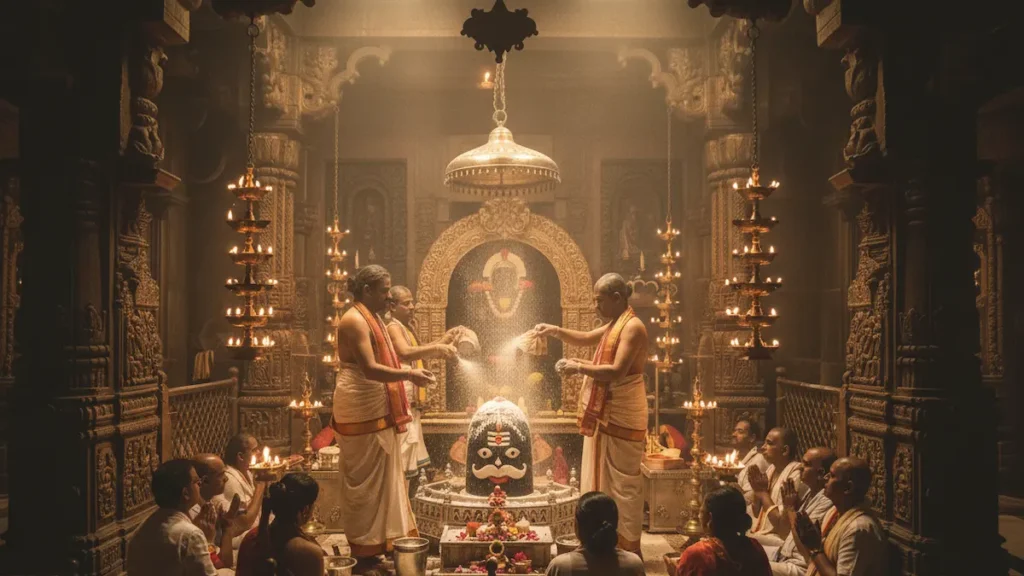
The sacred Bhasma Aarti performed at Mahakaleshwar Temple stands as one of the most extraordinary rituals of Hindu worship. Conducted in the early hours before dawn, the ceremony involves adorning the Jyotirlinga with sacred ash while priests chant Vedic hymns and perform ritual gestures with impeccable discipline.
The symbolism of Bhasma Aarti lies in the cosmic truth that life is transient and ultimately merges with the eternal. Through this ritual, devotees connect with the profound philosophy that liberation comes from realizing the ephemeral nature of existence. Witnessing the Bhasma Aarti is considered a rare and transformative spiritual experience, one that many pilgrims consider the pinnacle of their journey to Mahakaleshwar.
Worship Traditions and Ritual Significance
Ritual worship in Mahakaleshwar Temple draws from ancient Shaiva Agamic traditions. Devotees offer Bilva leaves, water, holy ash, flowers, milk, and honey, while the temple resonates with Rudra chants and Shiva hymns. The spiritual environment intensifies during Shravan month, Mondays, Ekadashis, Mahashivaratri, and Kartik observances.
Ujjain’s Kshipra River adds another dimension to the pilgrimage. Ritual baths and offerings along the riverbanks create a sacred continuity between nature, devotion, and cosmic order. Many devotees perform personal sankalp for peace, protection, spiritual clarity, and the removal of obstacles.
The Mahakal Corridor and Modern Redevelopment
The development of the Mahakal Corridor has transformed the temple precinct into a grand cultural space. Spanning vast landscaped areas with pathways, sculptures, murals, illumination, and seating spaces, the corridor bridges ancient sanctity with modern infrastructure. Depictions from the Shiva Purana on sculpted walls narrate mythological stories in a visual form accessible to all generations.
The corridor not only enhances the pilgrimage experience but also reinforces the cultural identity of Ujjain as a living center of Hindu tradition. The redevelopment showcases India’s dedication to preserving spiritual heritage while presenting it elegantly to contemporary visitors.
Festivals and Celebrations at Mahakaleshwar Temple
Mahashivaratri stands as the most significant celebration at Mahakaleshwar Temple. Devotees fast, perform night-long worship, and participate in grand temple rituals. The spiritual atmosphere during this festival becomes deeply immersive as chants, bells, drums, and offerings express devotion to the cosmic lord.
Shravan month draws large pilgrim gatherings as Shiva devotees from different regions undertake sacred travel. The Simhastha Kumbh Mela, held once in twelve years in Ujjain, magnifies the temple’s prominence. Millions gather to bathe in the Kshipra River, engage in spiritual discourse, and witness the confluence of devotion, tradition, and ascetic wisdom.
Pilgrimage, Travel and Darshan Details
Ujjain’s geographical accessibility makes Mahakaleshwar Temple a widely visited pilgrimage destination. Well-connected through rail, road, and nearby airports, the city supports a robust network of accommodations, transport services, and food facilities suitable for both short and extended pilgrim stays.
Darshan management systems have improved significantly, ensuring smoother queue movement, scheduled access, and guided facilities for senior citizens and families. Many pilgrims also explore adjacent sacred sites including Kaal Bhairav Temple, Harsiddhi Temple, Chintaman Ganesh Temple, and the riverside ghats, forming a comprehensive pilgrimage circuit within the city.
The Sacred Presence of Kaal Bhairav
Kaal Bhairav occupies a pivotal role in Ujjain’s spiritual ecosystem. Revered as the guardian of Mahakal, Bhairav protects the sacred territory and maintains cosmic discipline. Devotees traditionally seek blessings at the shrine of Kaal Bhairav before approaching Mahakaleshwar, honoring an ancient hierarchy of divine power.
Bhairav symbolizes fearlessness, divine justice, and mastery over time. His presence reinforces the deeper philosophical framework of the temple where cosmic order and divine protection converge.
Cultural Influence and Literary Associations
The cultural imprint of Mahakaleshwar Temple transcends religion and permeates literature, music, and regional identity. Ujjain has long been recognized as a cradle of intellectual brilliance and poetic expression. Classical poet Kalidasa is believed to have flourished here, drawing inspiration from the landscapes, festivals, and spiritual culture of the region.
The temple’s aura continues to influence modern writers, tourists, and cultural enthusiasts, enriching contemporary discussions on heritage and faith.
Mahakaleshwar Temple and Hindu Pilgrimage Tourism
Mahakaleshwar Temple forms a vital link in the Hindu pilgrimage network and contributes to India’s thriving religious tourism sector. Devotees undertaking broader Jyotirlinga yatras consider Ujjain an indispensable stop. The combination of ritual practices, heritage spaces, and infrastructure integration creates a harmonious pilgrimage environment.
The temple’s development also strengthens employment, cultural preservation, and inter-regional religious exchange. Pilgrims return with memories of devotion and spiritual reflection, nurturing India’s civilizational continuity.
Philosophical Concept of Time and Mahakal
The essence of Mahakal lies in the philosophical understanding of time. Shiva as Mahakal governs past, present, and future, dissolving all temporal boundaries. Devotees reflect upon this dimension as an invitation to transcend material concerns and align with spiritual awareness. The worship of Mahakal thus represents a journey beyond mortality towards eternal consciousness.
In this sense, Mahakaleshwar Temple is not merely a place of ritual worship; it is an experiential shrine of metaphysics, surrender, and liberation.
Final Thoughts
Mahakaleshwar Temple stands as a monumental emblem of devotion, time, and spiritual authority. Its mythology, history, architecture, rituals, and cultural significance capture the profound depth of Indian spirituality. Every pilgrim who visits Mahakaleshwar carries back an unspoken memory of divine energy, philosophical insight, and inner peace. Beyond its religious dimensions, the temple remains a living testimony to India’s civilization, heritage, and timeless devotion to Shiva in his majestic form of Mahakal.
FAQ
Mahakaleshwar is revered as a self-manifested Jyotirlinga and holds a distinguished position in Shaiva worship traditions.
The Bhasma Aarti at Mahakaleshwar is recognized as a deeply symbolic and spiritually transformative ritual.
Mahashivaratri, Shravan observances, and Simhastha celebrations draw vast pilgrim gatherings to Mahakaleshwar Temple.
Ujjain’s sacred landscape enhances the pilgrimage experience and preserves ancient cultural identity.
Category: Mahakaleshwar Temple | Jyotirlinga Temples | Hindu Pilgrimage

