Author: BhaktiParv.com
Introduction
Sri Chaitanya Mahaprabhu was born in 1486 in Nabadwip, West Bengal, during a time when spiritual life in India was deeply influenced by ritual practices and rigid social divisions. His life marked a turning point in the Bhakti movement, bringing devotion out of temples and into the hearts of common people. Through collective chanting, humility, and unconditional love for Lord Krishna, Sri Chaitanya Mahaprabhu reshaped devotional spirituality in India.
The teachings of Sri Chaitanya Mahaprabhu continue to inspire millions across the world. His emphasis on heartfelt devotion rather than ritual complexity made spiritual life accessible to everyone, regardless of caste, education, or social background.
Table of Contents
1. Divine Birth and Early Life
2. Scholarly Excellence and Spiritual Awakening
3. Core Teachings and Philosophical Foundation
4. The Sankirtan Movement and Social Impact
5. Pilgrimages and Mystical Devotion
6. Disciples and Spiritual Companions
7. Literary Legacy and Scriptural Influence
8. Foundation of Gaudiya Vaishnavism
9. Global Influence in Modern Times
10. Final Thoughts
11. FAQ Section
Divine Birth and Early Life
Sri Chaitanya Mahaprabhu was born as Vishvambhar Mishra on the full moon day of Phalguna. His birth coincided with a lunar eclipse, during which people were chanting the holy names of God. Devotees believe this divine timing symbolized his future mission of spreading congregational chanting.
He was lovingly called Nimai because he was born under a neem tree. From childhood, Sri Chaitanya Mahaprabhu displayed extraordinary intelligence and charm. Though playful and mischievous at times, he showed early signs of deep spiritual sensitivity. Whenever he heard the name of Krishna, his attention became fully absorbed.
His parents, Jagannath Mishra and Sachi Devi, raised him in a devotional environment. The sacred atmosphere of Nabadwip, a renowned center of Sanskrit learning, greatly influenced his early development.
Scholarly Excellence and Spiritual Awakening
As a young man, Sri Chaitanya Mahaprabhu became a respected scholar of Sanskrit grammar and logic. He opened a school and gained fame for his intellectual brilliance. At this stage of life, he was known more for scholarship than devotion.
A profound transformation occurred during his pilgrimage to Gaya. There, he met the saint Ishvara Puri, whose spiritual guidance awakened deep devotion within him. After receiving initiation, Sri Chaitanya Mahaprabhu experienced intense love for Lord Krishna.
This turning point shifted his life completely. The celebrated scholar became an ecstatic devotee. From that moment, Sri Chaitanya Mahaprabhu dedicated himself to spreading pure bhakti.
Core Teachings and Philosophical Foundation
The central message of Sri Chaitanya Mahaprabhu was simple yet profound: pure devotion to Krishna is the highest spiritual path. He emphasized chanting the holy names as the most effective practice in the present age.
The Mahamantra became the heart of his movement:
Hare Krishna Hare Krishna
Krishna Krishna Hare Hare
Hare Rama Hare Rama
Rama Rama Hare Hare
Sri Chaitanya Mahaprabhu taught that sincere chanting purifies the heart and awakens divine love. He rejected the idea that spiritual progress depends solely on ritual or social status.
His philosophy, Achintya Bheda Abheda, explains the simultaneous oneness and difference between the individual soul and the Supreme Lord. This balanced vision allowed devotees to experience closeness with God while maintaining reverence.
The Sankirtan Movement and Social Impact
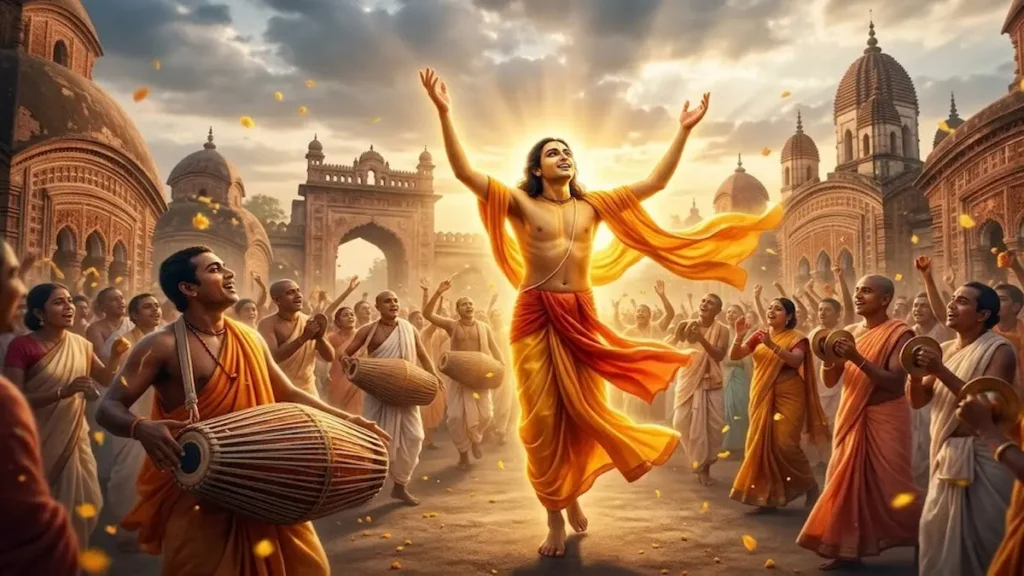
One of the most revolutionary contributions of Sri Chaitanya Mahaprabhu was the public chanting movement known as Sankirtan. Instead of limiting devotion to private worship, he encouraged collective singing and dancing in the streets.
This movement broke social barriers. People from different castes and communities joined together in devotion. Sri Chaitanya Mahaprabhu emphasized equality and spiritual unity.
Initially, local authorities opposed public kirtans. However, his peaceful determination and widespread support eventually led to acceptance. The Sankirtan movement became a spiritual revolution that transformed devotional culture in Bengal and beyond.
Pilgrimages and Mystical Devotion
Sri Chaitanya Mahaprabhu traveled extensively across India to spread his message. He visited sacred places such as Jagannath Puri, Vrindavan, and regions of South India. During these journeys, countless individuals were inspired by his humility and divine presence.
In Jagannath Puri, he spent many years immersed in devotion. Witnesses described his intense spiritual states during kirtan, where he would become absorbed in divine ecstasy. These experiences reflected the highest level of devotional realization.
His travels strengthened the Bhakti movement and established a network of devoted followers throughout the country.
Disciples and Spiritual Companions
Sri Chaitanya Mahaprabhu was supported by devoted companions who played a vital role in spreading his teachings. Among them were Nityananda Prabhu, Advaita Acharya, and other dedicated followers.
He guided his disciples with humility and compassion. Rather than presenting himself as superior, Sri Chaitanya Mahaprabhu often described himself as a servant of Krishna and the devotees. This deep humility became a defining feature of his movement.
His associates documented his teachings and ensured that his message would continue for generations.
Literary Legacy and Scriptural Influence
Although Sri Chaitanya Mahaprabhu wrote very little himself, his life and philosophy were preserved by disciples in important devotional texts. Works such as Chaitanya Charitamrita and Chaitanya Bhagavata provide detailed accounts of his teachings and spiritual experiences.
These texts form the foundation of Gaudiya Vaishnavism and remain central to devotional study. Through these scriptures, the teachings of Sri Chaitanya Mahaprabhu continue to guide spiritual seekers worldwide.
His doctrine of Achintya Bheda Abheda offered a unique synthesis of philosophical thought, harmonizing unity and diversity within divine reality.
Foundation of Gaudiya Vaishnavism
Sri Chaitanya Mahaprabhu is recognized as the central figure of Gaudiya Vaishnavism. This devotional tradition emphasizes loving worship of Radha and Krishna.
Under his inspiration, Vrindavan became an important center of devotional revival. Temples, devotional songs, and spiritual literature flourished. The emotional expression of divine love became the hallmark of this tradition.
The influence of Sri Chaitanya Mahaprabhu shaped the devotional culture of Bengal, Odisha, and North India in lasting ways.
Global Influence in Modern Times
The message of Sri Chaitanya Mahaprabhu crossed national boundaries in the twentieth century through dedicated teachers who carried forward his teachings. Congregational chanting and Krishna devotion spread across Europe, America, Africa, and Asia.
Festivals celebrating his appearance day, Gaura Purnima, are observed with devotion worldwide. Temples and spiritual communities continue to practice the principles he established centuries ago.
In a world facing division and unrest, the message of Sri Chaitanya Mahaprabhu offers harmony through devotion, humility, and collective remembrance of the divine.
Final Thoughts
Sri Chaitanya Mahaprabhu transformed the spiritual landscape of India by emphasizing love over ritual and devotion over hierarchy. His life demonstrates that sincere chanting and humble service are powerful paths to divine realization.
The Sankirtan movement he initiated continues to resonate in temples and communities across the globe. The legacy of Sri Chaitanya Mahaprabhu remains alive wherever the holy names are chanted with faith and devotion.
His message of unity, compassion, and divine love stands as a timeless guide for humanity.
FAQ Section
Sri Chaitanya Mahaprabhu as the pioneer of congregational chanting
He established Sankirtan as a collective spiritual practice that unites communities through devotion and joyful remembrance of Krishna.
Sri Chaitanya Mahaprabhu and Achintya Bheda Abheda philosophy
His philosophical teaching explains the simultaneous unity and distinction between the soul and the Supreme Lord.
Sri Chaitanya Mahaprabhu and Gaura Purnima observance
His appearance day is celebrated with devotional singing, fasting, and remembrance of his life and teachings.
Sri Chaitanya Mahaprabhu and the global Bhakti movement
His influence continues worldwide through devotional communities dedicated to chanting and Krishna worship.
Category: Sri Chaitanya Mahaprabhu | Bhakti Movement | Hindu Saints