Author: BhaktiParv.com
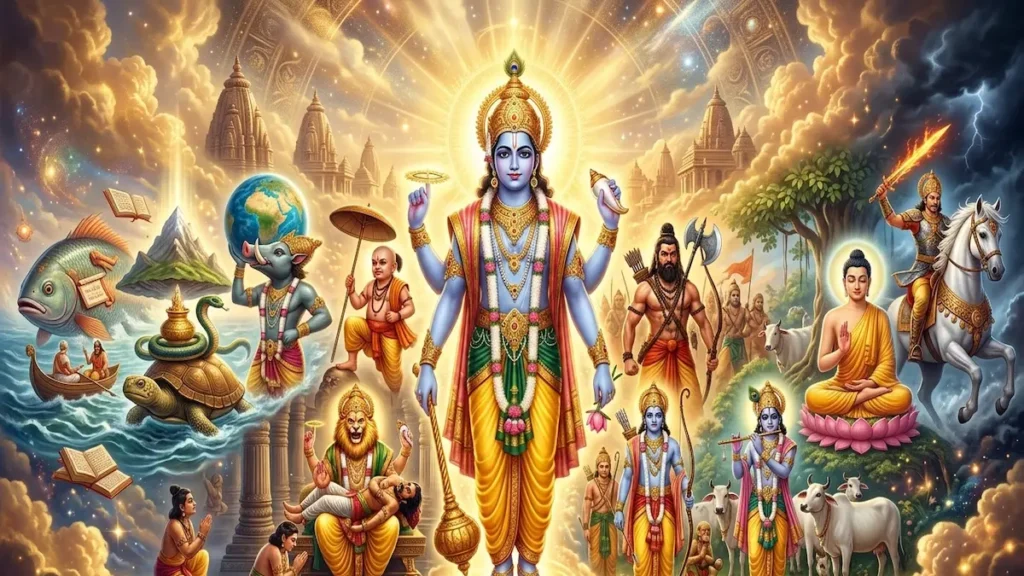
Lord Vishnu is one of the principal deities of Hinduism and is known as the preserver and protector of the universe. Whenever righteousness declines and chaos rises, Vishnu incarnates on Earth to restore balance and protect dharma. The Vishnu Avatar List describes these divine incarnations, which are collectively known as the Dashavatara. Each avatar represents a unique purpose and carries deep spiritual meaning rooted in Hindu philosophy and scriptures.
This detailed guide on the Vishnu Avatar List presents a complete, structured, and authoritative explanation of all ten major avatars of Lord Vishnu. It explores their stories, symbolism, and spiritual significance in a clear and human-friendly way suitable for readers seeking both knowledge and devotion.
Table of Contents
- Meaning and Concept of Vishnu Avatar
- Importance of the Vishnu Avatar List in Hinduism
- Matsya Avatar
- Kurma Avatar
- Varaha Avatar
- Narasimha Avatar
- Vamana Avatar
- Parashurama Avatar
- Rama Avatar
- Krishna Avatar
- Buddha Avatar
- Kalki Avatar
- Spiritual Evolution Reflected in the Vishnu Avatar List
- Cultural and Festival Significance of Vishnu Avatars
- Final Thoughts
- FAQ
Meaning and Concept of Vishnu Avatar
The word “Avatar” comes from the Sanskrit term “Avatara,” which means “descent.” In Hindu belief, an avatar is the divine descent of God into the earthly realm. The Vishnu Avatar List reflects the sacred promise that whenever evil grows and threatens cosmic order, Lord Vishnu takes birth in a specific form to re-establish righteousness.
This divine intervention is beautifully described in the Bhagavad Gita, where Lord Krishna, an incarnation of Vishnu, declares that he manifests age after age to protect the virtuous and destroy wickedness. The Vishnu Avatar List is therefore not just a mythological narrative but a profound spiritual doctrine that emphasizes divine compassion and cosmic balance.
Importance of the Vishnu Avatar List in Hinduism
The Vishnu Avatar List holds immense religious and philosophical importance. Each avatar represents a stage in cosmic protection and moral restoration. Together, these incarnations show that the Divine responds actively to human suffering and injustice.
Many scholars also observe that the sequence of the Dashavatara symbolically mirrors the theory of evolution—from aquatic life to advanced human consciousness. This unique perspective makes the Vishnu Avatar List both spiritually powerful and intellectually fascinating.
Matsya Avatar
Matsya is the first incarnation in the Vishnu Avatar List. In this form, Lord Vishnu appeared as a giant fish. According to the Puranas, a great flood threatened to destroy life and sacred knowledge. Vishnu, as Matsya, saved King Manu and protected the Vedas from being lost in the cosmic deluge.
The Matsya avatar symbolizes protection, guidance, and preservation of wisdom. It teaches that divine grace appears even in the most uncertain times to safeguard truth and knowledge.
Kurma Avatar
Kurma, the second name in the Vishnu Avatar List, represents the tortoise incarnation. During the great churning of the ocean, known as Samudra Manthan, Mount Mandara was used as a churning rod. To stabilize the mountain, Vishnu took the form of a giant tortoise and supported it on his back.
The Kurma avatar stands for patience, strength, and stability. It reminds devotees that divine support often works silently beneath the surface.
Varaha Avatar
Varaha, the third entry in the Vishnu Avatar List, is the boar incarnation. When the demon Hiranyaksha dragged the Earth into the cosmic ocean, Vishnu appeared as a powerful boar to rescue it.
The Varaha avatar signifies courage and the triumph of good over destructive forces. It emphasizes that the Earth itself is sacred and protected by divine power.
Narasimha Avatar
Narasimha, the fourth avatar in the Vishnu Avatar List, is a half-man, half-lion form. This incarnation was taken to defeat the demon king Hiranyakashipu, who had obtained a complex boon that made him nearly invincible.
Narasimha’s appearance demonstrated that divine intelligence transcends all conditions. The avatar symbolizes the protection of devotees and the destruction of arrogance.
Vamana Avatar
Vamana is the fifth figure in the Vishnu Avatar List. Vishnu incarnated as a dwarf Brahmin to humble the powerful king Bali. By asking for three steps of land and then expanding to cosmic size, Vamana reclaimed the universe for the gods.
This avatar represents humility, intelligence, and the restoration of divine order through wisdom rather than brute force.
Parashurama Avatar
Parashurama, the sixth name in the Vishnu Avatar List, was born as a warrior sage. He wielded an axe and fought against corrupt rulers who misused their power.
Parashurama represents discipline, justice, and moral courage. His story emphasizes that strength must serve righteousness.
Rama Avatar
Rama is one of the most revered figures in the Vishnu Avatar List. His life story is narrated in the Ramayana. Rama symbolizes ideal conduct, loyalty, and unwavering commitment to dharma.
Through his journey, Rama teaches the importance of integrity, duty, and compassion in both personal and social life.
Krishna Avatar
Krishna, the eighth avatar in the Vishnu Avatar List, is a central figure in the Mahabharata and the Bhagavad Gita. His life combines divine playfulness with profound spiritual wisdom.
Krishna represents love, devotion, and enlightened action. His teachings guide humanity toward spiritual awakening and righteous living.
Buddha Avatar
Buddha is included in the Vishnu Avatar List as the ninth incarnation. In this form, Vishnu appeared to promote compassion and non-violence.
The Buddha avatar highlights introspection, mindfulness, and the path of peace.
Kalki Avatar
Kalki is the final avatar in the Vishnu Avatar List and is yet to appear. According to scriptures, Kalki will manifest at the end of the current age to eliminate darkness and restore truth.
This future incarnation symbolizes hope, renewal, and the ultimate triumph of righteousness.
Spiritual Evolution Reflected in the Vishnu Avatar List
The Vishnu Avatar List is often interpreted as a symbolic journey of life’s progression. From aquatic forms to divine human incarnations, it mirrors growth in consciousness. This layered meaning enhances its spiritual depth and philosophical richness.
Cultural and Festival Significance of Vishnu Avatars
Many Hindu festivals celebrate different avatars. Ram Navami honors Rama, Janmashtami celebrates Krishna, and Narasimha Jayanti commemorates Narasimha. These festivals keep the Vishnu Avatar List alive in devotional practice.
Final Thoughts
The Vishnu Avatar List is not merely a collection of mythological stories. It is a profound spiritual framework that demonstrates divine intervention in times of moral crisis. Each avatar carries timeless lessons of courage, compassion, humility, and righteousness.
By understanding the Vishnu Avatar List deeply, devotees strengthen their faith and connect with the eternal promise that dharma will always prevail.
FAQ
The Vishnu Avatar List Represents Divine Protection
The avatars collectively demonstrate that the Divine actively protects the universe whenever injustice rises.
The Dashavatara Symbolizes Moral and Spiritual Growth
Each incarnation reflects a stage of human and cosmic development.
Kalki Avatar Signifies Future Renewal
The final avatar assures believers that truth will ultimately overcome darkness.
Category: Vishnu Avatar List | Lord Vishnu | Hindu Festivals